



Library of Knowledge
Library of Knowledge No. 46

Criteria from 1st January 2021.
From 1 January 2021, the period to be reviewed to determine eligibility for EWSS will be 1 January to 30 June 2021.
The reduction in turnover or customer orders (30%) between 1 January and 30 June 2021, is shown compared to the:
- same period in 2019, where the business operated for the whole of the comparable period in 2019
- period from the date of commencement to 30 June 2019, where the business commenced trading between 1 January and 1 May 2019
- projected turnover or customer orders from 1 January 2021, or date of commencement, to 30 June 2021, where business commenced after 1 May 2019. (This is compared to what the projections may have been if COVID-19 had not occurred.)
Note
You must retain evidence of appropriate documentation, including copies of projections to demonstrate continued eligibility over the specified period.
Monthly review to check eligibility
You are required to undertake a review on the last day of every month to ensure you continue to meet the eligibility criteria. July 2020 and the final month of the EWSS are exempt from this requirement.
Actions to take if you no longer qualify
You may find, after your monthly review, that you no longer qualify. If this is the case, you must:
- deregister from the EWSS
- cease claiming the subsidy
You must do this through ROS, with effect from the following day of the review (that being the first day of the month).
Qualifying childcare businesses
Childcare businesses, registered in accordance with Section 58C of the Child Care Act 1991, are included in the scheme. There is no requirement to meet the turnover test.
For more information see: https://revenue.ie/en/employing-people/ewss/qualifying-criteria-for-employers.aspx
Stay safe
Library of Knowledge No. 45

Re: 2020 Commercial Rates Waiver (update)
In Budget 2021, the Government announced an extension of the waiver of 2020 commercial rates for certain properties.
The initial 3 month waiver period from 27th March 2020 was extended twice, to 27th September 2020 and finally to 31st December 2020.
This waiver is recognition of the fact that not only were many ratepayers forced to close business due to the public health requirements, but also many that remained open suffered significant reductions in turnover.
The waiver will be applied automatically as a credit in lieu of commercial rates for the nine month period to classes of occupied rateable property where the occupying business is not in the excluded categories.
No application is required from those ratepayers to avail of the waiver.
Where a ratepayer who qualifies for the credit in lieu of rates has already paid their 2020 rates bill, a refund or a credit towards their 2021 rates bill will be arranged by the relevant Local Authority.
This credit does not apply to the following Excluded Categories:
- Public Service
- Global Utility Networks on the Central Valuation List
- Vacant Properties
- Individual Office Premises with an annual rates bill of €100k or greater in 2020*
- Individual Industrial Premises with an annual rates bill of €100k or greater in 2020*
- Supermarkets greater than 500M2 (Categories Supermarket 2 and Supermarket 3)
- Data Centres
- Incinerator, Generating Stations
- Landfill Sites
- Network (Cable)
- Network (Storm Water)
- Network (Water)
- Windfarms
- Generating Stations
- Banks
- Building Societies
- Pharmaceutical Manufacturing
- Computer/Technology/Electronic manufacturing
- Premises contracted to provide services related to the COVID 19 pandemic to/on behalf of the State, where the State is already compensating for rates as part of the contract between the occupier or service provider and the State.
Business in the excluded categories above may seek eligibility from their local County Council if it can be shown the business was severely impacted by the pandemic. The Council may request documentary evidence to support eligibility.
Re: 2021 Commercial Rates Waiver.
In order to continue the supports available for enterprise, and in recognition of the impact of the ongoing trajectory of COVID 19, a commercial rates waiver will be applied in the first quarter of 2021 to businesses most seriously affected by restrictions. The categories of business eligible for the waiver will be determined in line with Government decisions on level five restrictions. When finalised, details will be issued to local authorities to enable administration of the waiver.
Stay safe.
Library of Knowledge No. 44

The National Minimum Wage increased from 1 January 2021 this applies to most employees. It is the minimum hourly pay rate that must be paid. It applies to full-time, part-time, temporary and casual employees. However the following categories of employees are excluded:
- Employees who are close relatives of the employer, where the employer is a Sole Trader, such as a spouse, civil partner, parent, step-parent, grandparent, child, step-child, grandchild, sibling or half-sibling of the employer;
- A craft apprentice within the meaning of the Industrial Training Act, 1967, or the Labour of Services Act, 1987.
From 1 January 2021, the following rates apply:
| Age | Amount | % of NMW |
| Under 18 | €7.14 | 70% |
| 18 years old | €8.16 | 80% |
| 19 years old | €9.18 | 90% |
| National Minimum Wage (20+) | €10.20 | 100% |
Minimum rates of pay for other sectors
There are different minimum rates of pay for employees in other sectors which are set out in Sectoral Employment Orders (Construction Sector & Mechanical Engineering Building Services Contracting). Sector) and Employment Regulation Orders. (Contract Cleaning & Security Industry).
What can be included as pay for the National Minimum Wage (reckonable components) *
The following can be included to make up the national minimum wage
- normal basic pay
- shift allowances or other similar payments
- any fee, bonus or commission
- Zero Hours payments
- Board & Lodgings
- Service charge given through the payroll
What can’t be included for the National Minimum Wage (non reckonable components) *
The following payments cannot be included to make up the national minimum wage rate:
- any payment of expenses incurred by the employee in carrying out his/her employment
- Premiums including overtime, public holiday, Saturday, Sunday, unsocial hours or call out
- Allowances for special duties including a post of responsibility, on call or standby
- Tips or gratuities paid into a central fund and paid through the payroll
- any payment to the employee not made for their role as an employee
- any payment in kind or benefit in kind.
- any sum payable to an employee in lieu of notice of termination of employment.
*these are not full lists
For further information see https://www.workplacerelations.ie/en/what_you_should_know/hours-and-wages/national minimum wage/
Stay safe and well.
Library of Knowledge No. 43

A new Brexit Business Loan was announced on 23rd November 2020 today by the Tánaiste and Minister for Enterprise, Trade and Employment, Leo Varadkar T.D., to help small business prepare for Britain’s exit from the single market and customs union at the end of this year.
The introduction of the new Microfinance Ireland Brexit Business Loan will allow small firms whose turnover already is or is likely to fall 15% or more or if the business has a short term cashflow need as a result of Brexit, to take preparatory action for what could be some very difficult weeks and months ahead.
Product Features
- Loans from €5,000 – €25,000*
- Loan Terms from 6 months to 3 years** (shorter terms depending on purpose)
- Interest rate of 4.5% APR if submitted through the Local Enterprise Office Network or other referral partners or 5.5% APR if you apply directly
- No fees/charges or any hidden costs
- Fixed repayments with no penalty for early repayment
* Maximum credit exposure for all MFI borrowings is €25,000
**Depending on the term of the loan, interest only repayments for 3 months may apply in line with our standard products.
Eligibility.
- Any business* (Sole Trader, Partnership or Limited Company) with less than 10 employees and annual turnover of up to €2m
- Unable to secure finance from a Bank or commercial lending provider
- Business turnover is or potentially could be impacted by a minimum of 15% OR the business has a short term cashflow need as a result of Brexit.
* While Businesses involved in Alcohol Production are deemed to be an excluded sector for MFI Loans, they are eligible to apply for an MFI Brexit Loan.
For further information see: https://microfinanceireland.ie/loan-packages-2/brexit
Stay Safe
Library of Knowledge No. 42

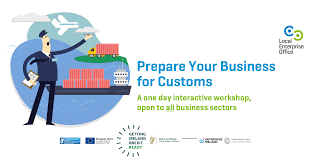
Local Enterprise Offices are running ‘Prepare Your Business for Customs’ workshops throughout the year and they’re open to ALL businesses, across ALL sectors and ALL industries.
To find out what’s covered in the workshop, read the course outline here.
These workshops are fully funded by the Department of Business, Enterprise and Innovation through Enterprise Ireland.
The aims of this workshop are to help Irish businesses understand:
- The administration process around import and export procedures.
- Customs formalities at borders.
- The Authorised Economic Operator (AEO) process.
- Tariffs and the cost implications of tariffs
- Import procedures, such as the Electronic
- Declaration Process and Automated Entry Processing (AEP)
Other Brexit Supports
There has never been more support available to small businesses. As hubs of expert advice, information and practical supports, dedicated Local Enterprise Office teams can help you manage your Brexit response through –
- Scorecards to help with planning.
- One-to-one mentoring.
- Specialist training and consultancy.
- Financial supports.
- Access to worldwide support networks.
To book your place, at any venue see: https://www.dfa.ie/brexit/events/list/future/local-enterprise-office-prepare-your-business-for-customs-online-workshops.php
Stay Safe
Library of Knowledge No. 41
There are less than 50 days to go until Brexit happens for real – bringing massive changes to the way that companies trade with the United Kingdom (excluding Northern Ireland).
Fortunately, there is now an extensive range of training material and information available online on the Government’s new Brexit Information Hub to help businesses prepare for Brexit and the lasting change that it will bring.
And it’s all free of charge.
Brexit means new customs procedures and regulatory requirements for anyone trading with the UK (excluding Northern Ireland).
The new hub provides resources, practical information and webinars for businesses to prepare across all key areas of change such as:
- Customs
- Controls
- Product Compliance and Certification
- Supply Chain
- Financial Management
- And more
The hub can be accessed via Gov.ie/getbrexitready
Stay Safe.
Library of Knowledge No. 40
The ‘KEEP WELL’ campaign was launched last week and we thought it a worthy of inclusion in our Library of Knowledge. There is no doubt each of us will find one element that would be personally beneficial.





- Keeping active – keeping active and being outdoors, even during the winter, is important to help physical and mental health and wellbeing.
- Staying connected – staying connected with people, addressing isolation, supporting volunteerism and initiatives that support person-to-person connection is important to our wellbeing.
- Switching off and being creative – switching off and being creative or learning something new, getting back to nature and finding ways to relax can help our general wellbeing.
- Eating well – by nourishing our bodies and minds, we can develop a better connection between the food we eat and how we feel and positively impact our physical and mental wellbeing.
- Minding your mood – equipping people with information on where to go if they need support. This will also be linked with the local community helpline to ensure that people can access the support they need.
For further information see https://www.gov.ie/en/campaigns/healthy-ireland/?referrer=http://www.gov.ie/healthyireland/
Stay Safe
Library of Knowledge No. 39

This new €20 million Ready for Customs grant, administered by Enterprise Ireland, will help SMEs involved in exporting and importing with the UK and further afield to put in place the staff, software and IT systems to be ready for new customs arrangements from 1 January 2021.
- Up to €9,000 is available for each new full-time employee engaged in customs work.
- If you employ a new person to deal with customs on a part-time basis a grant of up to €4,500 is available.
- This grant contributes to recruitment costs, employee costs and provision of IT infrastructure.
Applications are currently open. The application process will close when the €20m fund has been dispersed or on 15th December, 2020 at 3pm, whichever is earlier.
Businesses are advised to apply as early as possible for the scheme.
To submit your application go to http://enterprise-ireland.com/en/funding-supports/Company/Esetablish-SME-Funding/Be-Prepared.html.
Stay Safe.
Library of Knowledge No. 38
The COVID Restrictions Support Scheme (CRSS) came into effect on Tuesday 13th October 2020 and will end on 31st March 2021 (unless extended).
The scheme is not currently available to applicants. It is expected to be launched on or before Thursday 22nd October 2020.
Criteria:
- Available to businesses located in areas where Level 3 or higher are in place.
- Business must be significantly impacted or temporarily closed as a result of the health restrictions.
- Applies to business premises where restrictions directly prohibit or restrict access by customers.
- Turnover must have reduced by at least 80% compared to corresponding period in 2019 (exclusive of VAT)
- Will include accommodation, food and arts, recreation and entertainment sectors to level 3.
- When higher levels are announced, other sectors may be included.
Payments:
- Based on the businesses 2019 average weekly turnover, subject to a maximum weekly payment of € 5,000.
- Calculations will be based on 10% of the first € 1m million in turnover and 5% thereafter.
- The support represents a cash payment in respect of an advance credit in trading expenses for the period.
- Payments will be administered by Revenue.
Important Note
- The scheme will operate on a self-assessment basis and qualification will require a business to demonstrate that turnover has been severely impacted.
- Payments will automatically cease at the end of the COVID-19 restriction period.
- If restrictions are extended or re-introduced then a subsequent claim can be made.
Data extracted from Chartered Accountants Ireland.
Please contact our office should you require assistance with the application for this scheme.
Stay safe and well.
Library of Knowledge No. 37

The Scheme offers a partial Government guarantee (80%) to participating finance providers against losses on qualifying finance agreements to eligible SMEs, small Mid-Caps and primary producers.
It is designed to incentivise participating finance providers to continue to play their role in supporting the availability of additional liquidity to Irish businesses.
The Scheme is operated by the Strategic Banking Corporation of Ireland (SBCI) through participating finance providers. i.e. The loan is available through your financial providers BOI, AIB, Ulster Bank and KBC but is 80% guaranteed by SBCI (Strategic Banking Corporation of Ireland).
Scope of the scheme
The Scheme is targeted towards companies who are unable to access credit because of three distinct barriers to lending;
- Inadequate collateral.
- Novel business market, sector or technology which is perceived by lenders as higher risk under current credit risk evaluation practices.
- Need for refinancing caused by the exit of an SMEs lender from the Irish market.
Key features of the scheme
- Facilities of €10,000 up to €1m.
- Terms of up to 7 years.
- Term Loans, Demand Loans and Performance Bonds.
- You may be able to avail of between a three to six-month interest-only payment period.
- Initial product supported for the Scheme is a term loan.
What kind of businesses are eligible for the Scheme?
This Scheme is available to eligible SME and small Mid-Cap businesses, including primary producers (businesses engaged in farming and fishing), established in Ireland.
Your business must also have experienced an adverse impact of minimum 15% in actual or projected turnover or profit due to the impact of COVID-19.
For further information and full details are available through the SBCI website.
Stay Safe & Well.